
Shopify vs WordPress for Canadian Businesses in 2026

10Div Team
10Div Team

Shopify vs WordPress is one of the most common platform questions Canadian business owners ask — and for good reason. Both can power a professional online presence, but they solve different problems. Shopify is built for selling products with minimal technical overhead. WordPress is built for flexibility: content, custom design, SEO control, and optional e-commerce through WooCommerce. Choosing the wrong one usually means paying twice — once to launch, and again to migrate. This guide compares Shopify and WordPress for Canadian businesses in 2026 across cost, SEO, e-commerce, hosting, payments, bilingual needs, and long-term ownership so you can pick with confidence. Whether you are a London Ontario retailer, a Quebec bilingual brand, or a national DTC company, the decision framework below is the same: match the platform to how you actually grow — product checkout, content-led leads, or a hybrid of both.
If your business is primarily an online store and you want simplicity, Shopify is usually the better fit. If you need a content-rich site, full design control, local SEO landing pages, or a mix of marketing and selling, WordPress (often with WooCommerce) gives you more flexibility and ownership. Many Canadian businesses succeed on either — the right choice depends on whether selling products, publishing content, or custom functionality is your main growth engine.
This guide is for Canadian SMBs choosing a platform for the next three to five years — retailers, service businesses adding e-commerce, manufacturers selling direct-to-consumer, and content-driven brands that also need a shop.
Use this table as a decision snapshot. Dig into the sections below for Canadian cost, SEO, and payment details.
| Factor | Shopify | WordPress |
|---|---|---|
| Best for | Dedicated online stores | Content sites, blogs, flexible builds + optional shop |
| Ease of use | Very beginner-friendly | Moderate learning curve |
| Cost shape | Monthly plans + apps + fees | Build + hosting + maintenance (more variable) |
| SEO control | Good, some structural limits | Full control |
| Design flexibility | Theme + app ecosystem | Nearly unlimited |
| Ownership | Hosted SaaS (you rent) | You own the site files |
| Maintenance | Mostly handled by Shopify | You or your host/agency manage it |
| E-commerce depth | Native and mature | WooCommerce (powerful, more DIY) |
| Bilingual EN/FR | Possible via Markets/apps | Very flexible with proper setup |
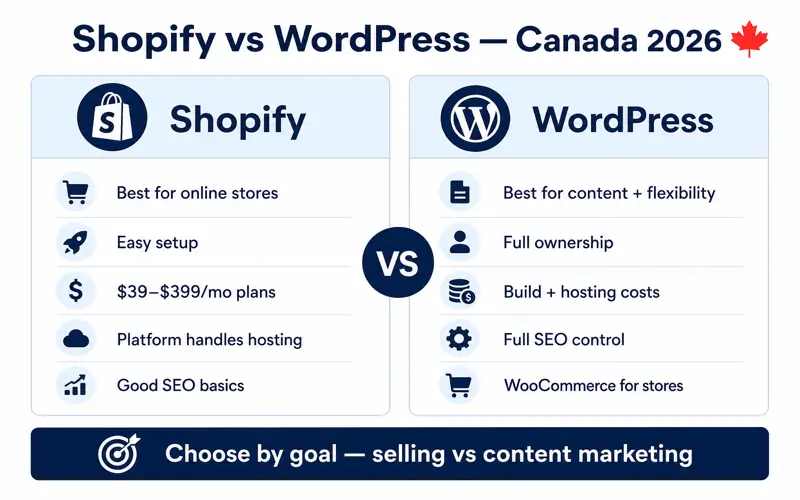
Shopify is predictable: a monthly plan (roughly $39 to $399 CAD depending on tier) plus payment processing and any paid apps. Theme customization or an agency build adds upfront cost, but day-to-day operations stay inside Shopify’s subscription model.
WordPress has a higher upfront build cost for a professional site — often $3,000 to $15,000 for Canadian SMBs depending on design and features — then lower recurring fees: managed hosting ($25–$100/month), plugin licenses, and optional maintenance. Over several years, WordPress can be cheaper for content-heavy sites. Shopify can be cheaper for a straightforward store you do not want to host or patch yourself.
Hidden costs matter on both sides. Shopify apps can stack quickly. WordPress needs disciplined updates and security. Budget for either app sprawl or maintenance — not neither.
For a realistic Canadian SMB budget: a Shopify Basic store with a solid theme and light agency setup might launch for a few thousand dollars plus monthly fees. A custom WordPress marketing site with a few conversion pages often lands in the mid thousands. A full WooCommerce catalogue with custom design sits higher. Ask any agency for a three-year total cost of ownership (build + subscriptions + apps + maintenance) — not just the launch quote — before you decide.
Both platforms can rank. Google cares about content quality, page experience, crawlability, and authority — not whether you chose Shopify or WordPress. That said, the tools you get out of the box differ.
WordPress gives deeper control over URL structure, schema markup, redirects, and content hubs. That helps when SEO and blogging are core to lead generation — local service pages, guides, and cluster content around your offers.
Shopify handles the basics well and continues to improve. Many stores rank successfully. Advanced SEO teams sometimes hit structural limits that need workarounds. For product-led stores with strong merchandising and reviews, Shopify SEO is often enough.
Bottom line: if organic content and complex site architecture are your growth plan, WordPress usually wins. If product pages and paid traffic drive most revenue, Shopify’s SEO ceiling is rarely the blocker.
Local SEO tip for Canada: service businesses that need city pages, Google Business Profile alignment, and long-form guides almost always prefer WordPress. Product brands that win on category pages, reviews, and shopping ads are usually fine on Shopify. Match the platform to the SERP you actually want to own.
Shopify is purpose-built for selling — inventory, checkout, payments, shipping rules, and abandoned-cart tools work with less setup. That speed is why many Canadian DTC brands start here.
WooCommerce (on WordPress) is more flexible and has no Shopify platform subscription. You control the stack, but you (or your agency) own hosting, security, performance, and updates. Complex catalogues or hybrid content+commerce sites often land on WooCommerce because everything lives in one CMS.
Canadian payments: Shopify Payments and third-party gateways cover most needs. WooCommerce commonly connects Stripe, PayPal, and Moneris. Factor gateway fees and CAD tax display (GST/HST/PST) into either build.
Shopify includes hosting. Speed and uptime are largely Shopify’s job. Heavy apps or unoptimized themes can still slow a store — but you are not picking servers yourself.
WordPress requires hosting. Managed WordPress hosting ($25–$100/month) is the right tier for most business sites. Done well, WordPress can score excellent Core Web Vitals. Done poorly, it becomes slow and fragile. Security also becomes your responsibility: updates, backups, firewalls, and monitoring.
If you serve Quebec or need credible French pages nationally, plan bilingual structure early. WordPress is typically more flexible for unique French copy, hreflang, and EN/FR templates. Shopify can support multiple languages through Markets and apps, but serious bilingual SEO still needs proper localization — not machine-only translation.
Very simple brochure sites with almost no growth plan can use a lighter builder short-term. Complex web apps, booking platforms, or multi-tenant systems may need custom development beyond Shopify themes or standard WordPress. In those cases, start with goals and integrations — then pick the stack.
Moving from Shopify to WordPress (or the reverse) is doable but not free. You must map URLs with 301 redirects, migrate products/customers carefully, re-test checkout, and preserve SEO equity. If you already rank for important terms, treat migration as an SEO project — not just a design refresh.
Common migration pitfalls: losing review history, breaking image URLs, forgetting XML sitemap updates, and launching without a redirect map. Plan a soft launch, monitor Search Console for crawl errors, and keep the old site (or a staging archive) available until rankings stabilize.
Ask these five questions before you buy a theme or sign a build quote:
If checkout and simplicity dominate, lean Shopify. If content, SEO control, and ownership dominate, lean WordPress. If both matter equally, many Canadian brands run WordPress for marketing and a Shopify store on a subdomain — or WooCommerce all-in-one.
Both can rank well on Google.ca. WordPress offers deeper control over URLs, schema, and content structure. Shopify covers SEO basics well with some structural limits. For most businesses, content quality and technical execution matter more than the platform logo.
Shopify has predictable monthly plan fees plus apps and transaction costs. WordPress usually has a higher upfront build cost and lower recurring fees (hosting + maintenance). Over several years, WordPress can be cheaper for content-heavy sites; Shopify can be cheaper for a straightforward store you do not want to maintain.
Yes. WooCommerce turns WordPress into a full e-commerce platform with no Shopify-style platform fee, though you manage hosting, security, updates, and payment setup yourself or with an agency.
Yes, but migrations need careful product/data export, URL redirects, and SEO preservation. It is almost always cheaper to choose well upfront than to migrate after you have rankings and reviews on one platform.
If you are mainly selling products and want speed, start with Shopify. If content marketing, local SEO, and custom pages matter as much as selling — or selling is secondary — WordPress is usually the better foundation.
Both can work. WordPress with a multilingual plugin (or custom EN/FR structure) is often more flexible for hreflang and unique French copy. Shopify supports multiple languages via apps and Markets, but complex bilingual SEO usually needs more careful setup.
Shopify has built-in payments plus third-party options. WordPress/WooCommerce can connect Moneris, Stripe, PayPal, and other gateways Canadian stores use — with more configuration work, but full control.
Yes. Many Canadian brands run a WordPress site for blogs, service pages, and local SEO, then send shoppers to a Shopify store on a subdomain or separate domain. It adds some complexity (two systems, shared branding, tracking), but it can be the right split when content SEO and checkout reliability both matter.
We will look at your goals, catalogue, and SEO needs — then recommend Shopify or WordPress honestly and build it right.



10Div Team
WooCommerce vs Shopify is the fork most Canadian product brands hit…
10Div Team
Google Business Profile optimization is still one of the highest-leverage local…
10Div Team
Creating a website is still one of the highest-return projects a…