
WooCommerce vs Shopify for Canadian Ecommerce

10Div Team
10Div Team
WooCommerce vs Shopify is the fork most Canadian product brands hit when WordPress is already in the room — or when a founder wants to sell online without rebuilding the whole marketing site. Shopify is a hosted commerce engine with a polished admin and App Store. WooCommerce is a PHP plugin on WordPress that turns your existing site into a store you fully own. Both can process cards, ship with Canada Post, and collect GST or HST. They diverge on control, content, and who maintains the stack.
This guide is for owners and developers comparing platforms for a.ca storefront in 2026 — not a generic feature list. If you are still deciding whether WordPress belongs in the picture at all, read Shopify vs WordPress for Canadian businesses first. When you need a team to implement either path, see our web development services in Canada.
Shopify runs your catalog, checkout, and hosting in one account. You theme inside their Liquid system or buy a theme; deeper changes often mean apps or Shopify Plus. WooCommerce sits on WordPress: MySQL stores products as custom post types, PHP renders templates, and you choose hosting, caching, and plugins. That split is why WooCommerce pairs naturally with content-heavy brands — blogs, landing pages, and bilingual URLs live beside the cart without a second CMS.
For a Canadian merchant selling coast to coast, architecture matters at tax time and at integration time. WooCommerce exposes hooks and the REST API for custom ERP or inventory bridges. Shopify pushes you toward approved apps and webhooks. Neither is wrong; the question is whether your team wants open PHP/MySQL or a managed commerce core with fewer moving parts.
| Area | WooCommerce | Shopify |
|---|---|---|
| GST/HST | Plugins + manual zones | Built-in Canadian tax profiles |
| Interac | Via Stripe or Moneris gateways | Shopify Payments where supported |
| Bilingual | WPML/Polylang on same install | Markets + translation apps |
| Data / PIPEDA | You choose host + vendors | Shopify as processor of record |
Provincial tax rules are not optional. WooCommerce Tax or dedicated Canadian extensions map rates by province; Shopify can automate much of that inside checkout. PIPEDA still applies to how you handle customer data — document processors whether you self-host WordPress or use Shopify’s cloud. Bilingual stores often lean WooCommerce when marketing and catalog share one WordPress install — see bilingual websites in Canada for URL and copy patterns.
If the business is half editorial — guides, recipes, B2B resources — WooCommerce on WordPress keeps everything in one sitemap and one internal-link graph. Shopify blogs exist but feel secondary in many themes. WordPress gives fine-grained control over schema, canonicals, and hreflang when you serve English and French. Local intent still depends on execution: fast mobile templates, clean URLs, and alignment with Google Business Profile — pair either stack with local SEO in Canada.
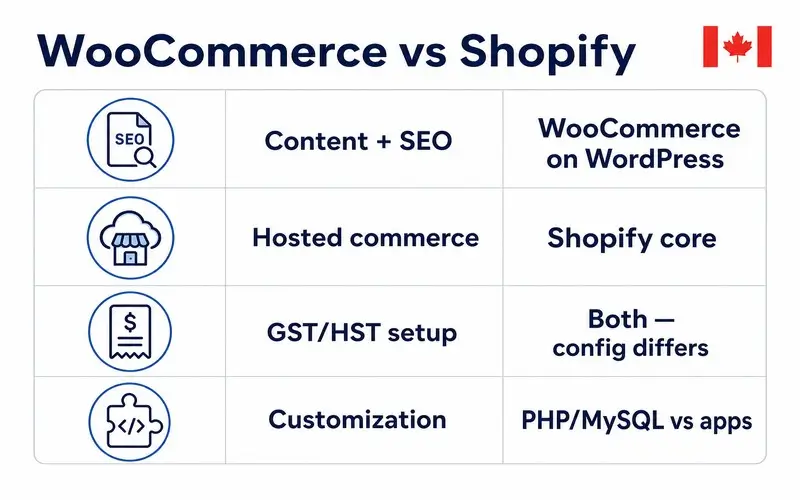
Shopify shifts hosting, SSL, and platform updates to Shopify. Your job is products, theme tweaks, and app hygiene. WooCommerce means managed WordPress hosting, plugin updates, staging, and backups on your side — or your agency’s. WooCommerce reward is flexibility: custom checkout fields, membership tiers, or a wholesale portal in PHP without waiting for an app vendor.
Canadian teams without a dedicated developer often start Shopify for speed. Teams already running WordPress for lead gen frequently add WooCommerce instead of splitting content and commerce. Agencies like 10Div often inherit WooCommerce when the marketing site was WordPress first.
Stripe, Moneris, and PayPal all integrate with both ecosystems. Interac e-Transfer and debit preferences vary by province and customer age; gateways expose what shoppers expect at checkout. Shipping tables for Canada Post, Purolator, or flat regional rates are configurable in WooCommerce zones; Shopify uses shipping profiles and carrier-calculated options. Neither platform removes the need to test checkout on a real phone on LTE in Toronto or Vancouver.
Choose WooCommerce when you already invest in WordPress content, need deep PHP customization, run complex B2B rules, or want full database access for reporting. Choose it when bilingual marketing and catalog must share templates and when leaving a SaaS commerce fee model matters strategically — not because you heard WordPress is “free,” but because ownership and extensibility are priorities.
Choose Shopify when the team wants commerce-first admin, minimal server care, and a large app marketplace for reviews, subscriptions, and POS. It suits DTC brands focused on paid social and a tight catalog more than fifty landing pages a quarter. Custom app work still happens — see Shopify app development best practices — but the core cart is stable and hosted for you.
Write down integrations (ERP, email, accounting), languages, who updates products weekly, and whether the site is primarily content or primarily checkout. Prototype checkout and a product detail page on both if the decision is close. Measure mobile speed with real images, not placeholders. The right platform is the one your team will keep secure and fast twelve months after launch.
Catalog shape drives platform fit more than slide decks admit. WooCommerce handles variable products, bundles, and custom attributes through PHP and plugins — ideal when SKUs mix sizes, finishes, and B2B price tiers. Shopify manages variants cleanly inside admin but pushes exotic logic toward apps or Shopify Functions. If merchandising updates weekly and marketing publishes daily, ask whether product and content should share one WordPress install or stay split across Shopify and a blog subdomain.
Import and export matter at launch. WooCommerce CSV import is mature for simple catalogs; messy legacy data often needs a one-time script in PHP. Shopify’s import tools are friendly for straightforward lists but less forgiving when meta fields proliferate. Plan a dry-run import before you promise a go-live date to stakeholders.
Wholesale portals, net-30 terms, and role-based pricing are common in industrial and food-service verticals. WooCommerce B2B plugins layer on native roles and hidden categories. Shopify offers B2B channels on higher plans with company profiles and payment terms. Neither removes the need to test that a logged-in buyer sees correct tax and shipping — guest checkout tests alone will miss half the bugs.
| Scenario | WooCommerce | Shopify |
|---|---|---|
| Content-led store | Strong — one CMS | Blog is secondary |
| POS + online | Plugins + hardware partners | Shopify POS native |
| Marketplace feeds | Feed plugins | App ecosystem |
| Custom ERP sync | REST API + PHP | Admin API + apps |
Moving from Shopify to WooCommerce — or the reverse — is a data and URL project, not a theme swap. Product URLs, collection paths, and blog posts all need redirect maps. Teams that chose WooCommerce often cite database access and the ability to host on infrastructure they control. Teams that chose Shopify cite fewer 2 a.m. security pages. Document the decision so future hires understand why checkout behaves the way it does.
Klaviyo, Mailchimp, and Meta pixels attach differently on each platform. WooCommerce fires hooks PHP developers can extend; Shopify uses apps and server-side events. Test abandoned-cart flows in both English and French if you run bilingual campaigns. Consent banners must align with CASL — firing pixels before consent creates compliance risk regardless of platform.
Shopify’s App Store accelerates reviews, subscriptions, and loyalty — each app adds monthly fees and another vendor in your stack. WooCommerce plugins vary in quality; vet update cadence and support before install. Technical debt shows up when five apps each inject JavaScript on checkout. Audit apps quarterly and remove duplicates. A lean WooCommerce stack with custom PHP for your unique rules often outperforms a Shopify store with fifteen overlapping apps on Black Friday.
Yes. Configure tax zones by province with WooCommerce Tax or Canadian-focused extensions. Validate rates with your accountant for your product categories.
Generally yes for day-to-day catalog and orders. WooCommerce is easier when you already live in WordPress for content and want one login.
Either can rank. WordPress/WooCommerce often wins on content architecture and custom schema; Shopify wins on operational simplicity. Execution matters more than logo.
Yes, with a planned URL, redirect, and product data migration. Treat it as a project with SEO checkpoints, not a weekend export.
Yes. Pick managed WordPress hosting sized for cart traffic, with staging, backups, and a CDN for local visitors.
We build and tune ecommerce on WordPress and can help you compare platforms with your real catalog and integrations.




10Div Team
Shopify vs WordPress is one of the most common platform questions…


David Nguyen
Choosing the right theme is crucial when setting up your Shopify…


Kate Bairstow
Shopify has emerged as one of the leading e-commerce platforms, empowering…