
Bilingual Websites in Canada: English, French, and SEO That Works

10Div Team
10Div Team

Serving Canada often means serving two official languages — not just swapping a few menu labels. Whether you are required to offer French in federal contexts or you simply want Quebec and Francophone customers to trust your brand, a bilingual website is a business decision with technical and SEO consequences. Done poorly, you create duplicate content, broken hreflang, and a French section that reads like machine translation. Done well, you build two credible experiences that share infrastructure and reporting. Here is how Canadian businesses plan URL structure, content workflows, and design for English and French without doubling every cost.
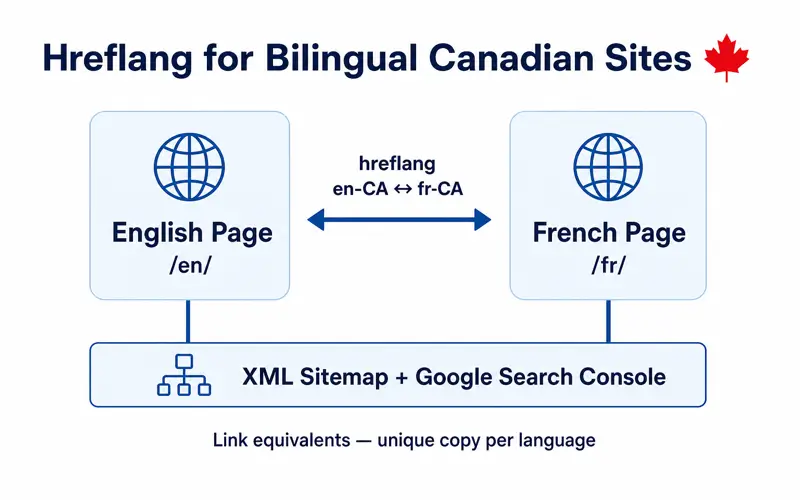
Subdirectories (/en/ and /fr/) on one domain are the most common choice for Canadian companies. They consolidate authority, simplify SSL and hosting, and work well with hreflang annotations. Subdomains (fr.example.ca) or separate domains can make sense for distinct brands but add management overhead and split analytics unless you are disciplined.
Avoid automatic IP-based language redirects without a visible toggle. Many users prefer English in Montreal or French outside Quebec. Let people choose and remember their preference with a cookie or account setting.
Legal, cultural, and pricing nuances differ by province. Quebec consumers expect French that sounds local, not Parisian marketing copy pasted from English. Budget for transcreation — adapting headlines, CTAs, and examples — not just word-for-word translation. Your French service pages should stand alone as useful pages, not thin duplicates.
| Approach | Pros | Cons |
|---|---|---|
| Professional human translation | Quality, brand voice | Higher cost, slower updates |
| Translation memory + human edit | Faster updates | Needs glossary discipline |
| Machine translation only | Cheap | Risky for trust, compliance, and SEO |
Use hreflang tags linking English and French equivalents. Submit both language versions in Search Console. Keep titles and meta descriptions unique per language. If a page exists only in one language, do not point hreflang to a forced translation stub — omit or use x-default thoughtfully.
Canadian English and French keyword research differ. ‘Impôt’ vs ‘tax’, ‘magasinage’ vs ‘shopping’ — your French keyword map should be built with Francophone search data, not guessed from English volumes.
Place the language toggle in the header where people expect it. Label with language names (English / Français), not flags alone. Keep layout direction and components consistent so switching language does not feel like a different brand. Forms, error messages, and transactional email must match the language of the page submitted.
Expect meaningful but not always double cost: shared templates and CMS fields reduce duplication. Content and QA are where hours multiply. For a mid-sized corporate site, planning 30–50% added effort for French versus English-only is a reasonable planning range, higher if you have large product catalogues or regulated copy.
Quebec users notice awkward translations instantly. Invest in Francophone copywriters who understand local idioms, measurement units, and regulatory references. Pricing in CAD with clear tax language builds trust; vague shipping policies to Quebec during peak season create support load.
Customer service channels should match site language — if FR pages promise support en français, staff or documented escalation paths must exist. Analytics should segment conversions by language to prove the investment; if French pages convert half as well as English, diagnose UX and copy before blaming demand.
For federal contractors and grant recipients, document language compliance in your content workflow. Version control in the CMS with approval states for FR reduces launch-day panic when legal approves English but not French.
Not legally for every private business, but it is often required for federal funding, some RFPs, and for credible Quebec marketing.
Not if hreflang and unique copy are correct. Penalties show up as confusion — wrong language ranking in the wrong province.
Not for professional brands or SEO you care about. Widget quality and indexing are poor substitutes for real French pages.
Use fr-CA hreflang and tone suited to Canadian French; avoid mixing European French idioms on commerce sites.
We structure URLs, templates, and hreflang so both languages perform — whether you are launching bilingual from day one or retrofitting an existing site.




10Div Team
Google Business Profile optimization is still one of the highest-leverage local…
10Div Team
Google AI Overviews are changing how Canadians find answers — and…
10Div Team
If you run a business in Canada and send promotional emails,…