
CASL Email Marketing in Canada: A Practical Guide for 2026

10Div Team
10Div Team
If you run a business in Canada and send promotional emails, CASL is not optional reading. Canada’s Anti-Spam Legislation sets the rules for commercial electronic messages — emails, texts, and similar messages that encourage someone to buy, donate, or engage with a commercial offer. Plenty of owners learn about it the hard way: a complaint, a blocked list, or a scare from legal counsel after a campaign that “worked fine” in the United States. This guide explains what CASL expects in plain language, how consent actually works, and how to build email programs that stay useful without putting your brand at risk.
CASL focuses on commercial electronic messages (CEMs). If the purpose of the message is to encourage participation in a commercial activity — a sale, a webinar pitch, a service offer, a newsletter that routinely promotes your products — it usually falls under the law. Messages sent only to fulfill a transaction the person already started (order receipts, shipping updates, password resets) are treated differently and are generally allowed when they are transactional, not promotional.
CASL also reaches beyond email. Text messages and certain social direct messages can count when they are commercial. If your team is blasting SMS “flash deals” to a purchased list, you have a CASL problem, not just a deliverability problem. The safer habit is simple: treat any unsolicited commercial outreach the same way you would treat a formal email campaign.
Most of the confusion sits here. Under CASL, you generally need consent before you send a commercial electronic message. That consent comes in two flavours, and they are not equal.
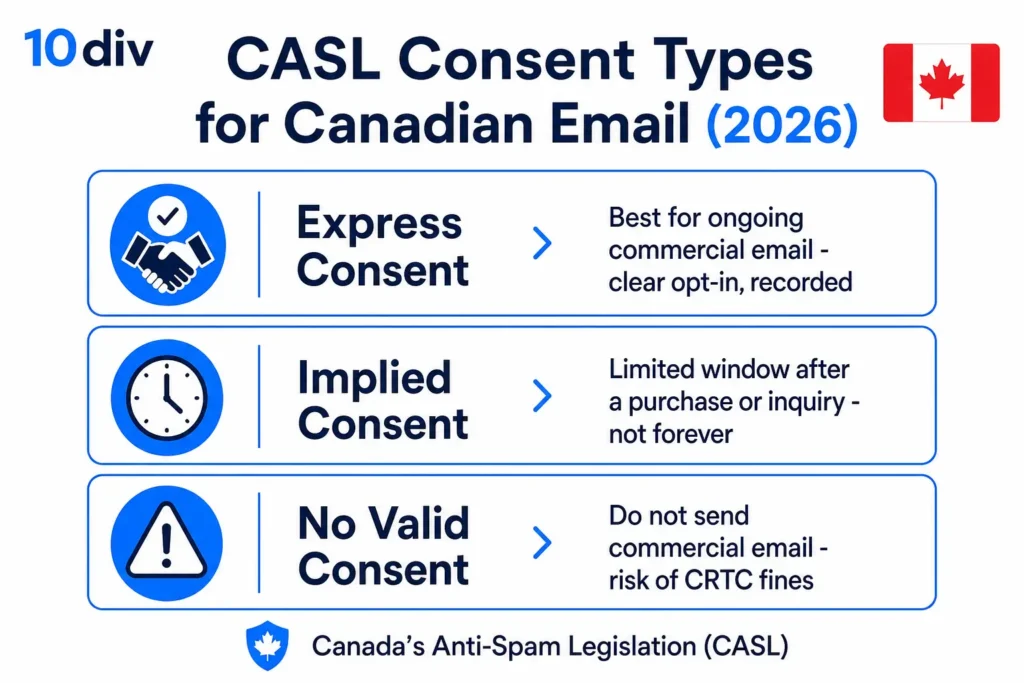
Express consent is the gold standard. Someone actively agrees to receive commercial messages from you — for example, checking an unchecked box on a form, confirming a double opt-in, or signing a clear paper authorization. You should record who consented, when, how, and what they agreed to receive. Express consent does not expire on a fixed calendar date the way some implied forms do, but people can withdraw it at any time, and you must honour that quickly.
Implied consent can exist after a purchase, an inquiry, or certain business relationships — but it is limited. Typical windows are short (often measured in months, not years), and the rules are specific. Relying on “they bought from us once in 2019” is a common way teams get into trouble. If you cannot clearly explain why implied consent still applies to a given contact today, do not send them a promo. Ask for express consent instead.
Purchased email lists are a red flag in Canada. Even if a vendor claims the list is CASL-compliant, you are responsible for the messages you send. Scraping addresses from websites or LinkedIn and adding them to a nurture sequence is not a growth hack — it is a compliance risk. Build your list through your own forms, events, content downloads, and customer relationships.
Consent is only half the story. CASL also expects identification and an easy unsubscribe.
From a practical marketing view, these requirements also improve trust. Canadians are used to seeing who is emailing them and how to opt out. Vague “noreply” brands with no street address or phone look spammy even when the offer is legitimate.
You do not need a legal department to run email well. You need a process your team can follow every week.
Use clear language: what will you send, how often, and who you are. Prefer unchecked boxes for marketing consent. Separate “create my account” from “send me offers” so people are not forced into a newsletter to finish a purchase. If you operate in Quebec or serve French-speaking customers, offer the consent language in French as well — clarity matters in both languages.
Double opt-in is not always mandatory, but it is strong evidence. Store the timestamp, IP or form source, and the exact consent wording in your ESP or CRM. When staff leave and tools change, those records are what protect you.
Customers, trial users, event attendees, and cold leads should not sit in one bucket. Segmentation helps relevance and keeps you from stretching implied consent past its useful life. A monthly newsletter for express subscribers is different from a short follow-up after someone requests a quote.
CASL does not ban good marketing. It bans careless outreach. Subject lines should match the body. Offers should be honest. Track open rates if you want, but judge success on clicks, replies, and revenue — and on how few people hit unsubscribe or spam. Rising complaint rates are a product and list problem, not a “deliverability trick” problem.
Penalties can be serious, and enforcement is real enough that brands take notice. Even without a fine, spam complaints damage inbox placement. Once Gmail and Outlook decide you are noisy, winning trust back is slower and more expensive than building the list properly the first time.
Email works best when it supports the rest of your funnel: SEO content people actually asked for, landing pages that match the promise, and paid campaigns that do not dump unqualified contacts into a blast list. If you are comparing channels, our guides on digital marketing costs in Canada and SEO versus Google Ads are useful companions. For a full-service view of email, content, and paid media under one strategy, see our Digital Marketing Services in Canada page.
Often you have a path through implied consent for a limited time after a purchase or certain business relationships — but it is not a blank cheque. For ongoing newsletters and promotions, express consent is the safer long-term approach.
If the newsletter includes commercial content or promotes your business, treat it as a commercial electronic message and get appropriate consent. A purely informational employee bulletin is a different situation; most marketing newsletters are not.
You can usually follow up on the inquiry itself. Turning that person into a long-term promo subscriber requires clear consent for that purpose. Do not quietly add every form fill to a weekly deal list.
CASL does not replace good localization. If you serve French and English audiences, ask for consent in the language of the form and send content that matches their preference. Translation alone is not a strategy — relevance is.
If your list is messy, your forms are unclear, or you are not sure whether last year’s leads can still be emailed, it is worth fixing before the next campaign. We will tell you straight what to fix first — free 30-minute strategy session, no obligation.

10Div Team
Google Business Profile optimization is still one of the highest-leverage local…
10Div Team
Google AI Overviews are changing how Canadians find answers — and…

10Div Team
Serving Canada often means serving two official languages — not just…