
Google AI Overviews for Canadian Businesses in 2026

10Div Team
10Div Team
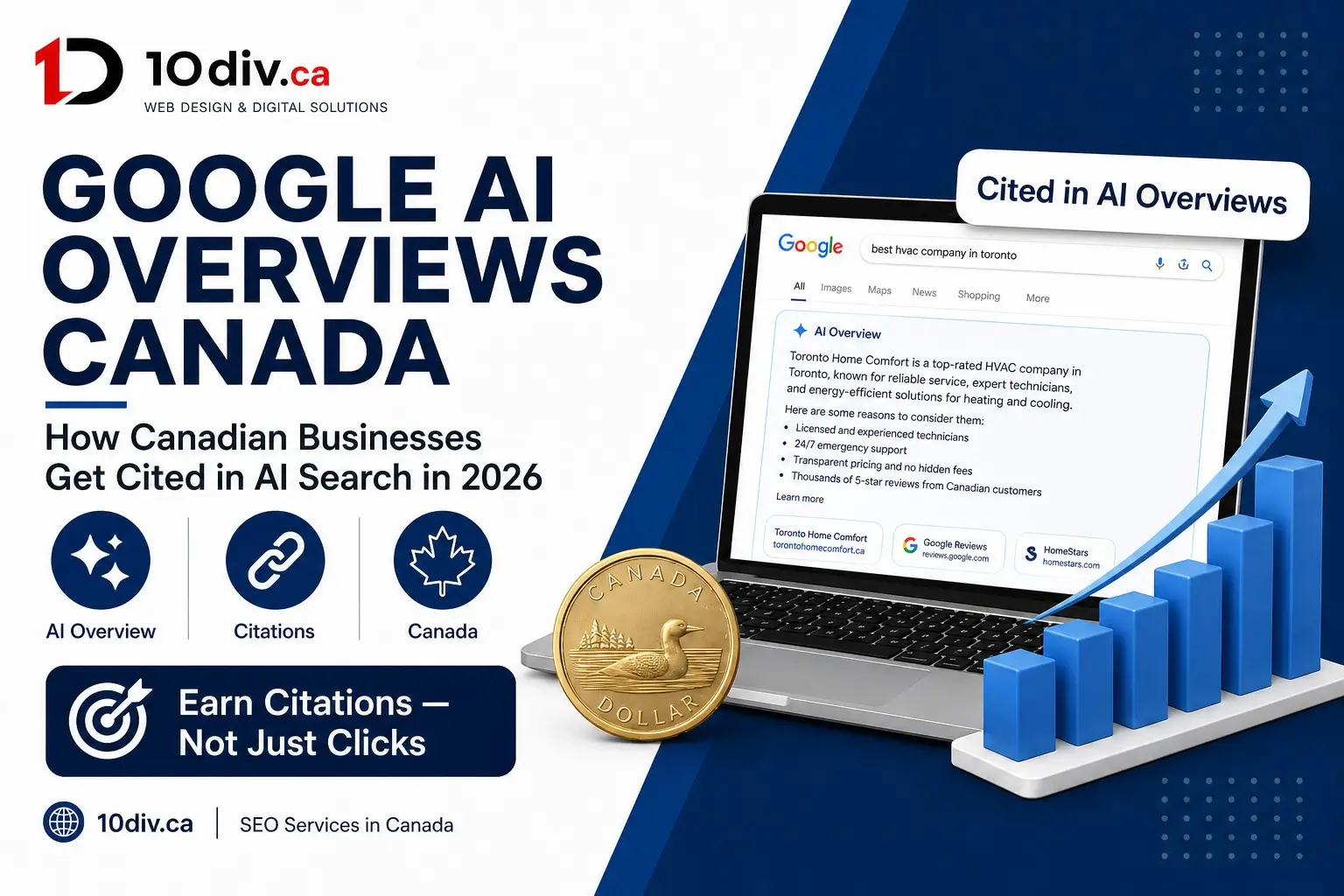
Google AI Overviews are changing how Canadians find answers — and how businesses get discovered. Instead of only a list of blue links, Google often shows a generated summary at the top of Search, with citations to the sources it used. For Canadian SMBs, that means visibility is no longer only about ranking #1 organically. You also want to be the brand Google trusts enough to cite when someone asks “best local SEO agency in London Ontario,” “how much does a website cost in Canada,” or “is Shopify or WordPress better for my store.” This guide explains what AI Overviews are in 2026, how they relate to classic SEO (and to terms like GEO and AEO), what actually helps you get cited, and a Canada-specific checklist you can act on without chasing hacks. If you already invest in SEO, you are not starting over — you are tightening the same fundamentals so generative features can find, trust, and quote you.
When someone searches on Google.ca, Google may show an AI-generated overview above the classic results. That overview synthesizes information from multiple sources and links out to cited pages. It is designed to help users get oriented quickly — especially on multi-part or exploratory questions.
Important nuance for 2026: AI Overviews sit on top of Google’s existing search systems. They are not a random chatbot inventing your brand. If your site is thin, blocked from crawling, or unclear about who you are and what you offer, you are unlikely to be a preferred citation — just as you struggle in classic organic results.
You will hear Generative Engine Optimization (GEO), Answer Engine Optimization (AEO), and “AI SEO.” For Google Search specifically, Google’s own guidance is clear: generative AI features rely on the same core ranking and quality foundations as traditional Search. Helpful, people-first content still wins.
What to ignore: gimmicks that claim special AI files, content “chunking” as a ranking trick, or buying inauthentic mentions. What to double down on: crawlability, clear answers, expertise signals, accurate business entities, structured data that matches the page, and pages that deserve to be cited.
Think of GEO/AEO as a lens, not a new religion: same site, same Googlebot, higher bar for clarity and trust. Agencies that sell “AI Overview packages” disconnected from technical SEO and content quality are usually selling hope. Ask them how their work maps to Google’s published Search documentation — not a third-party dashboard score.
Google does not publish a public “AI Overview ranking formula.” Practically, cited pages tend to share traits:
For local Canadian queries, Google Business Profile accuracy, categories, photos, posts, and review quality remain foundational. AI features can include local business information when it helps the user — incomplete or inconsistent NAP data still hurts you.
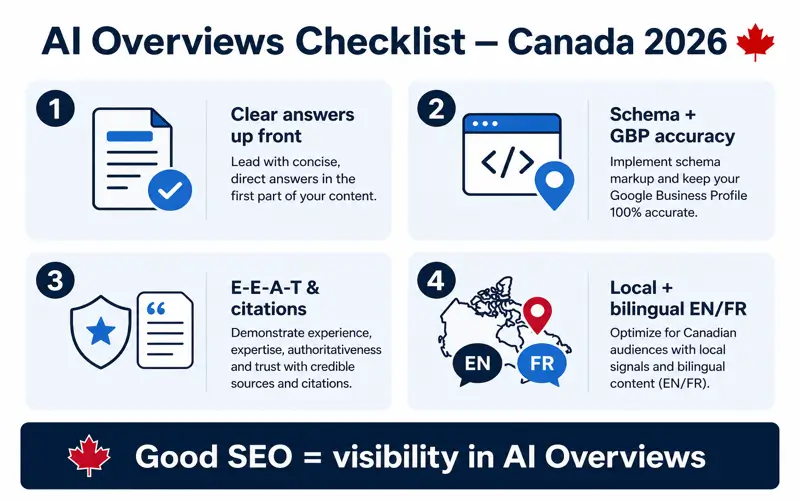
Open important pages with a clear 60–120 word answer to the primary question, then expand with proof, examples, and FAQs. AI systems and humans both reward pages that do not hide the point.
Use consistent organization name, address, phone, service areas, and hours on your site and Google Business Profile. Add Organization / LocalBusiness schema that matches visible content. Keep CAD pricing, Canadian spelling, and provincial context when relevant — they signal Canada intent.
Original frameworks, process steps, cost ranges with caveats, screenshots of your methodology, and client-safe case details outperform generic AI-written roundups. If every competitor says the same thing, Google has little reason to prefer you.
Use descriptive H2/H3s, short paragraphs, FAQ sections, and tables where comparisons help. FAQPage schema can help when FAQs are genuine page content — not stuffed invisible text.
Publish real local pages (city + service) only when you serve that market. For French audiences, write unique FR pages with hreflang — do not mirror thin EN copy. Reviews that mention specific services and neighbourhoods help both classic local SEO and AI summaries.
Use Google Search Console for queries, pages, and (as available) generative AI performance reporting. Track branded search lift, citation screenshots for priority prompts, and leads — not vanity “AI score” tools that invent rankings Google never published.
| Content type | Why it helps | Canada example |
|---|---|---|
| Definitive guides | Clear answers + depth | Local SEO Canada guide |
| Cost explainers | Numbers users ask for | Website / SEO cost in CAD |
| Comparisons | Decision queries | Shopify vs WordPress |
| How-to + checklists | Step extraction | How to create a website in Canada |
| Local service pages | Entity + intent match | SEO London Ontario |
| Policy / compliance | Trust + uniqueness | CASL email marketing rules |
AI Overviews will not rescue a site Google cannot crawl well. Fix indexation, canonicals, XML sitemaps, mobile usability, Core Web Vitals, and broken internal links. Keep robots.txt from blocking important paths. Serve HTTPS. Update stale pages with real 2026 facts instead of changing only the year in the title.
Retailers: keep Merchant Center product data clean. Service businesses: keep GBP categories and services accurate. Both feeds and profiles help Google understand what you sell when AI answers include products or local options.
Classic organic results still matter. Many commercial and navigational queries still show a traditional SERP, Local Pack, or shopping units. AI Overviews appear more often on informational and multi-intent questions. Your strategy should cover both: pages that rank and pages worth citing.
When an Overview answers the question completely, click-through can drop. When the answer is partial, controversial, or needs a quote, calculator, booking flow, or local proof, users still click. Build content that is citable and clickable — summaries for scanners, depth for buyers.
AI Overviews are AI-generated summaries that appear at the top of some Google Search results. They pull from Google’s index and quality systems, then cite sources so users can dig deeper. They are part of Search — not a separate product you “opt into” as a publisher.
For Google Search, good GEO/AEO is largely good SEO. Google has said generative AI features are built on the same ranking and quality foundations as classic results. Focus on helpful, crawlable content, clear entities, and accurate business info — not tricks like llms.txt or fake “AI schema.”
They can reduce clicks on some informational queries when the Overview answers the question fully. They can also send qualified traffic when your page is cited and users want depth, tools, quotes, or local proof. Measure both classic clicks and AI-feature impressions in Search Console as Google rolls out reporting.
Strong Google Business Profile data, consistent NAP, reviews with specific detail, LocalBusiness schema, and authoritative local content still matter most. AI features often surface the same businesses that already win the Local Pack and organic local queries.
Yes when the query intent is language-specific. Unique French pages with proper hreflang beat thin machine translations. AI systems still need clear, factual answers in the language the user searched.
Be careful. Blocking Googlebot harms Search overall. Other bots (for training vs search) are separate decisions. For Google AI Overviews specifically, your content needs to remain crawlable and indexable by Google.
Ads and organic/AI visibility solve different jobs. Ads can capture demand immediately. AI Overviews and organic results build durable authority. Most Canadian growth plans need both strategy and measurement — not one or the other.
Update when facts, prices, laws, or your services change — not on a vanity calendar. Fresh, accurate pages with clear authorship beat yearly republishes that only change the date. Prioritize money pages and high-impression queries in Search Console first.
We build the SEO, content, and technical foundation Canadian businesses need for classic Search and generative AI features.
10Div Team
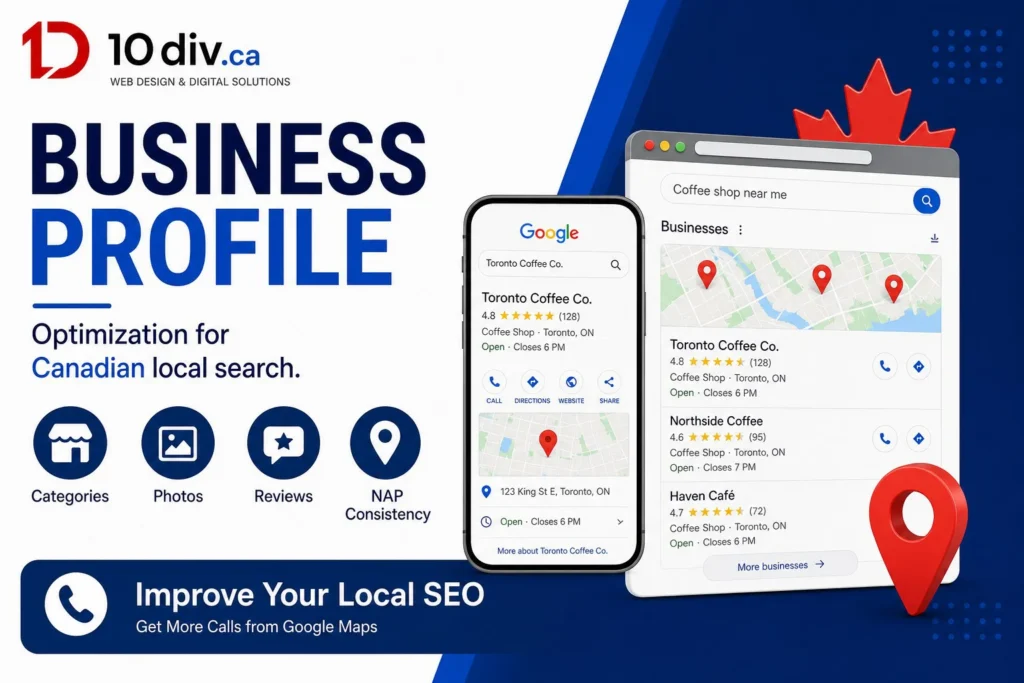
Google Business Profile optimization is still one of the highest-leverage local…
10Div Team
If you run a business in Canada and send promotional emails,…
10Div Team
Serving Canada often means serving two official languages — not just…